Module 1: Story Foundations
Section outline
-
-
Module 1: Story Foundations
Story Foundations
How Humans Turn Life into Narrative
Goal: By the end of this module, participants will understand what transforms everyday events into compelling stories and why narratives captivate audiences emotionally and cognitively. This foundation equips participants to spot and craft stories in audiovisual media using simple tools like smartphones. The overall goal is participants to understand what makes something a story and why stories affect people.
-
What elements compose a story: character, goal, obstacle, change.
-
Why the brain loves stories: emotion, meaning, and memory.
-
The difference between events and narrative (raw footage vs crafted story).
-
Introduction to story structure: (3 act structure) beginning, middle, end.
-
The core of story: conflict and stakes.
-
Examples from film, social media videos, and documentaries.
-
Exercise: transforming a simple real-life event into a story outline.
-
Audio-visual focus: recognising story elements inside video clips.
1. What Elements Compose a Story: Character, Goal, Obstacle, Change
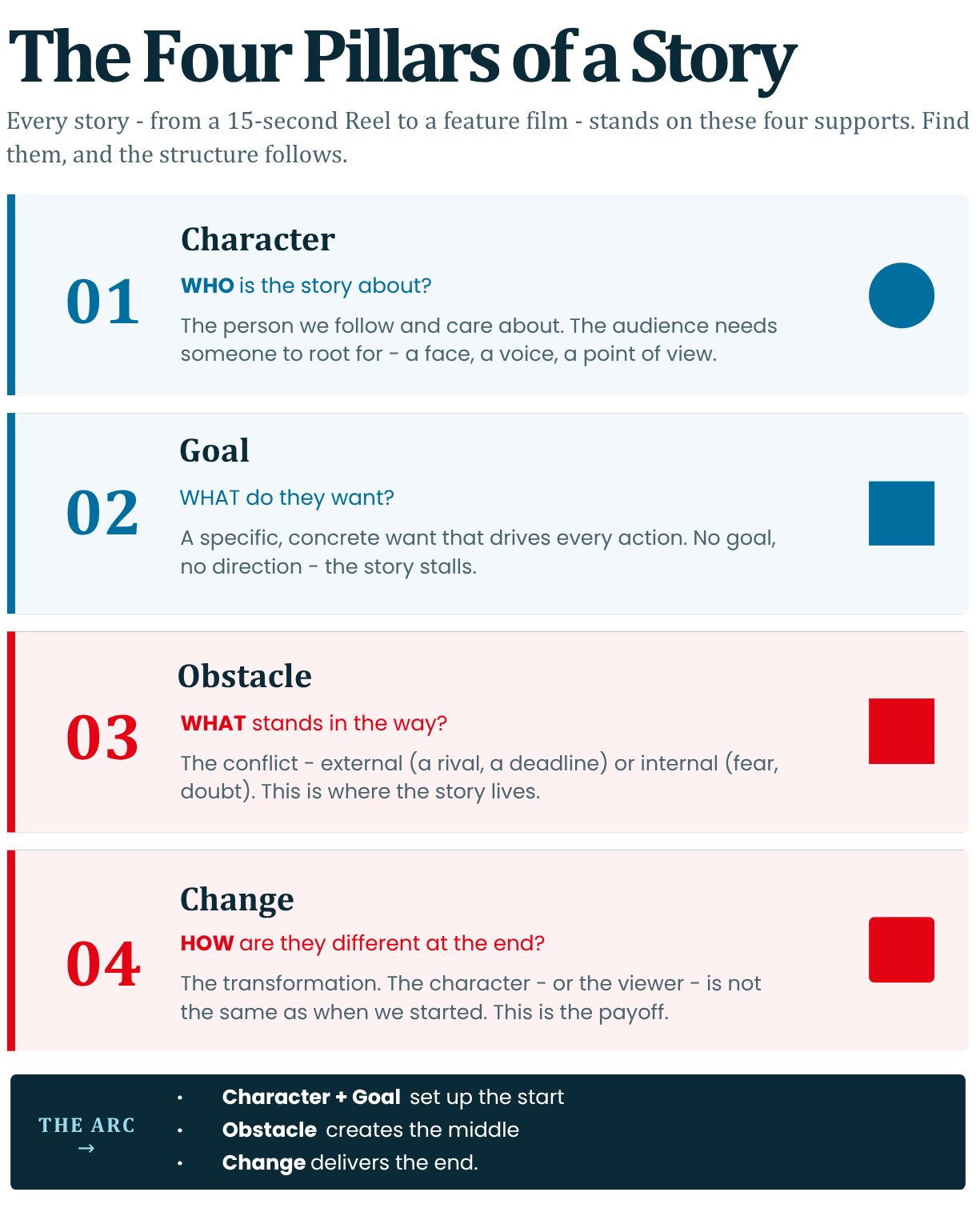
At its core, a story boils down to four essential elements that give it life and momentum. These aren't abstract concepts - they are the building blocks filmmakers, TikTok creators, and documentarians use to hook viewers.
- Character: The 'who' driving the story. Not just any person, but one with desires, flaws, or relatability. In audio-visual terms, reveal them through actions, expressions, or dialogue rather than exposition.
Example: A shy teen (character) filming their first vlog.- Goal: What the character wants. It creates direction and urgency. Make it specific and personal
Example: specific 'win the school talent show' vs. vague 'be happy'.- Obstacle: The "but" that blocks the goal. External (rainy weather ruins outdoor shoot) or internal (fear of judgment). This sparks tension.
- Change: The transformation at the end. The character grows, fails, or shifts perspective. Without it, there's no payoff
Example: teen overcomes nerves, posts the vlog, gains confidence.These elements create propulsion: Character pursues Goal, hits Obstacle, emerges Changed. In video clips, scan for them: Does the shot linger on a determined face (goal)? A slammed door (obstacle)? A smile post-struggle (change)?
Reference: Pixar storytelling rules emphasise ‘Once upon a time there was ___. Every day, ___’ to embed these upfront (Pixar in a Box, Khan Academy).
https://www.youtube.com/watch?v=1rMnzNZkIX0&list=PL64d_z5MCoeg5fKLqnVvGuIJvzsdhJ10rWatch: Pixar in a Box storytelling playlist
Read: Khan Academy - Pixar in a Box: The Art of Storytelling
Explore Further: Pixar - Pixar in a Box overview
Exercise: Watch a 15-second Instagram Reel. Label the four elements.
2. Why the Brain Loves Stories: Emotion, Meaning, and Memory
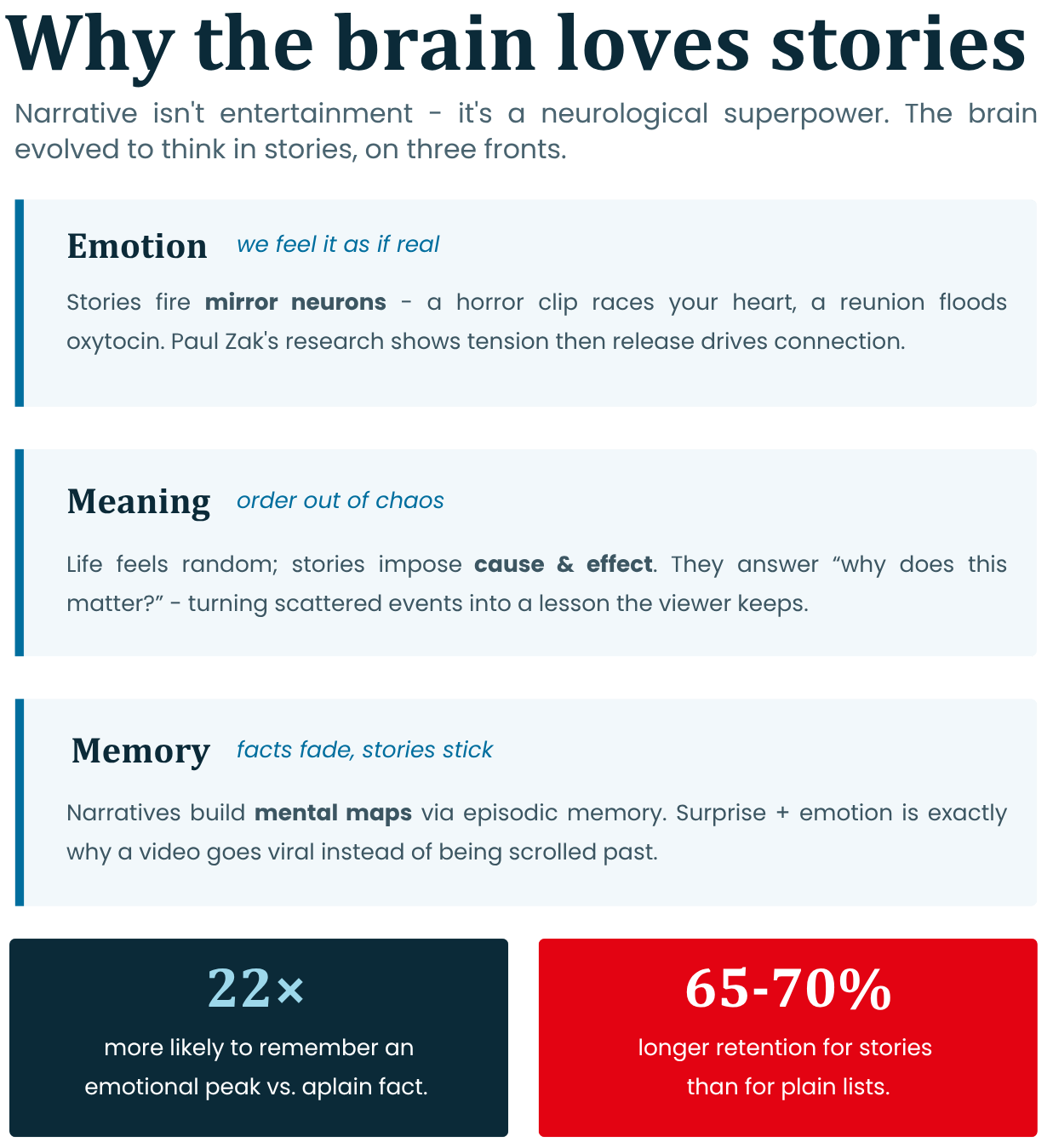
Stories aren't entertainment - they're neurological superpowers. Human brains evolved for narratives to process the world, survive threats, and bond socially.
- Emotion: Stories trigger mirror neurons, simulating experiences as if real. Fear in a horror clip? Your heart races. Joy in a reunion scene? Oxytocin floods for connection. This beats facts: Emotional peaks make viewers 22x more likely to remember (Perkins School of Data Science study).
- Meaning: Life feels chaotic; stories impose order. They answer 'Why does this matter?' via cause-effect chains, turning random events into lessons. Documentaries excel here - e.g., explaining climate change through one family's journey.
- Memory: Narratives create 'mental maps'. Facts fade; stories stick via episodic memory (hippocampus activation). Social media thrives on this: Viral videos embed via surprise + emotion.
For youth creators: Use close-ups for emotion, arcs for meaning. Brains retain stories 65-70% longer than lists (Noble Desktop).
Neuroscientist Paul Zak's research shows stories raise cortisol (tension) then oxytocin (release), boosting retention (TED Talk: "The Moral Molecule").
Watch: Paul Zak TED Talk - Trust, morality and oxytocin
Read: Paul J. Zak - Why Inspiring Stories Make Us React
Audio-Visual Tip: In clips, note swelling music (emotion) or voiceover "aha" (meaning).
3. The Difference Between Events and Narrative (Raw Footage vs Crafted Story)
Events are unfiltered reality; narratives are sculpted truth. Spot the gap to elevate your videos from amateur to pro.
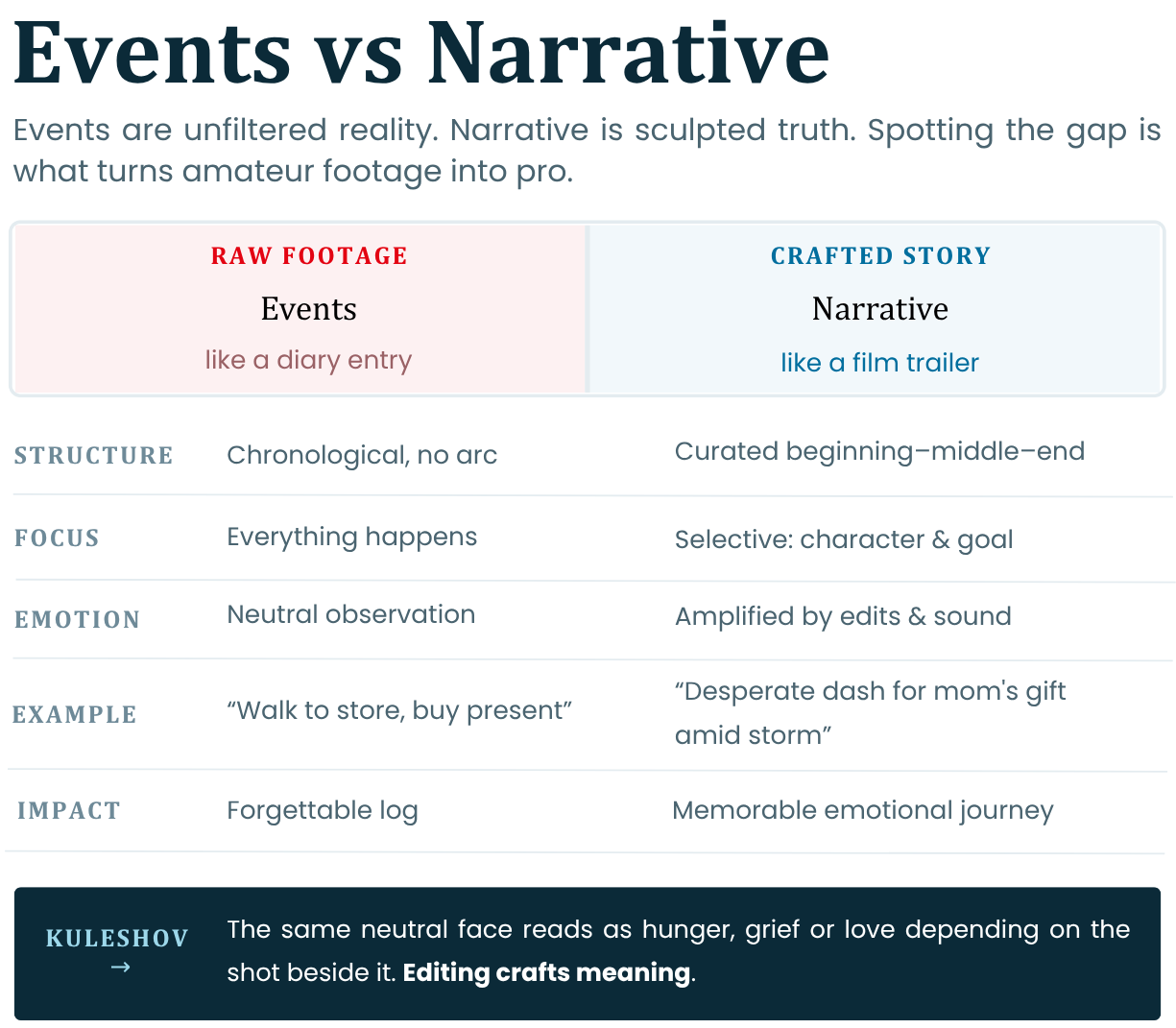
Raw footage is like a diary entry.
Narrative is like a film trailer.
In post-production, cuts imply meaning - e.g., shaky cam for chaos vs steady for resolve.Social media: Raw vlog flops; edited with music hooks viewers.Reference: The Kuleshov Effect (1920s Soviet editing): Same actor's neutral face + soup = hunger; + woman = lust. Proves editing crafts narrative from events (Film Editing Theory). https://www.youtube.com/watch?v=96xx383lpiI
Read: Videomaker - The Kuleshov Effect | StudioBinder - Kuleshov Effect examples
Exercise: Grab raw phone footage; rewatch to find a story.
4. Introduction to Story Structure: 3-Act Structure (Beginning, Middle, End)
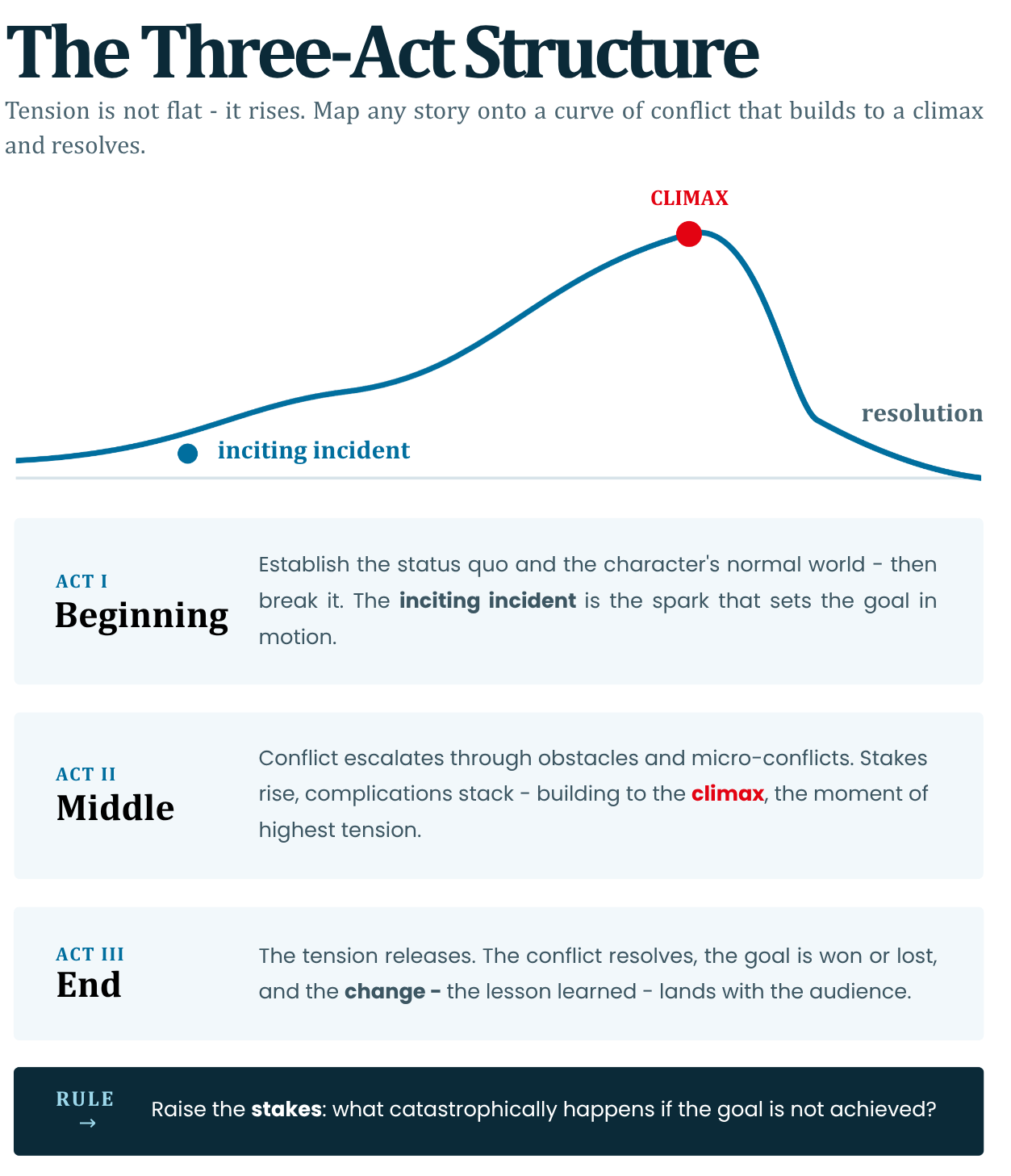
The 3-Act Structure is storytelling's universal blueprint - simple yet powerful for short videos. Divide your 1-3 minute clip accordingly.
- Act 1: Beginning (Setup, 25% runtime): Introduce character, world, goal. Hook immediately (question/action).
Example: Wide shot of bustling street; zoom to protagonist checking watch (stakes: late for audition).- Act 2: Middle (Confrontation, 50% runtime): Escalate obstacles. Build tension via quick cuts, rising music.
Example: Traffic jam, phone dies—internal doubt montage.- Act 3: End (Resolution, 25% runtime): Climax + change. Payoff feels earned.
Example: Run finale, nail audition, reflective smile.Visualise as a wave: Rise (Acts 1-2), peak (climax), fall (resolution).
Fits TikToks (15s Act 1 hook) to docs.Syd Field's "Screenplay" popularised 3-Acts for film; applies to shorts (used in Sundance labs).
Read: StudioBinder - Three Act Structure in Film
Exercise: Draw 3 boxes per act for planning.
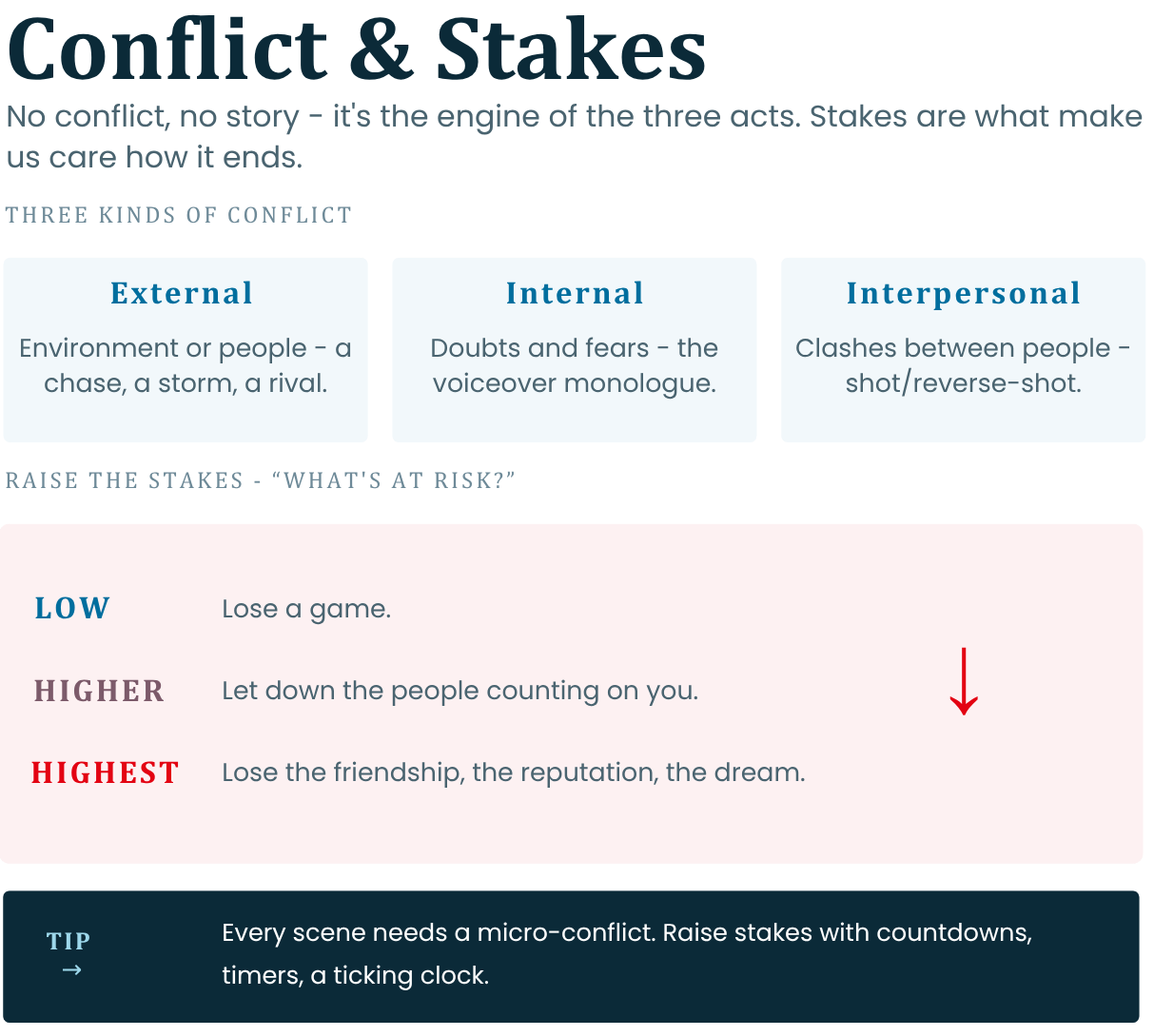
5. The Core of Story: Conflict and Stakes
No conflict, no story—it's the engine propelling the 3-Acts. Stakes make us care.
Conflict Types:
- External: Environment/people (chase scene).
- Internal: Doubts/fears (voiceover monologue).
- Interpersonal: Clashes (argument shot reverse-shot).
Stakes: "What's at risk?"
- Low: Lose a game.
- High: Lose friendship/reputation/dream.
Raise via countdowns (for example timer overlay).
In audio-visuals:
Conflict via cross-cuts (protagonist vs antagonist).
Stakes via dialogue ("If I fail, the team's done").
Social media: Drama = views; resolution = shares.
Robert McKee's "Story" defines conflict as "life vs death" metaphorically, even in comedies.
Read: McKee Story - Inner Conflict and Forces of Antagonism | McKee Story - Do Your Scenes Turn?
Tip: Every scene needs micro-conflict to sustain momentum.
6. Examples from Film, Social Media Videos, and Documentaries
Apply elements to real media:
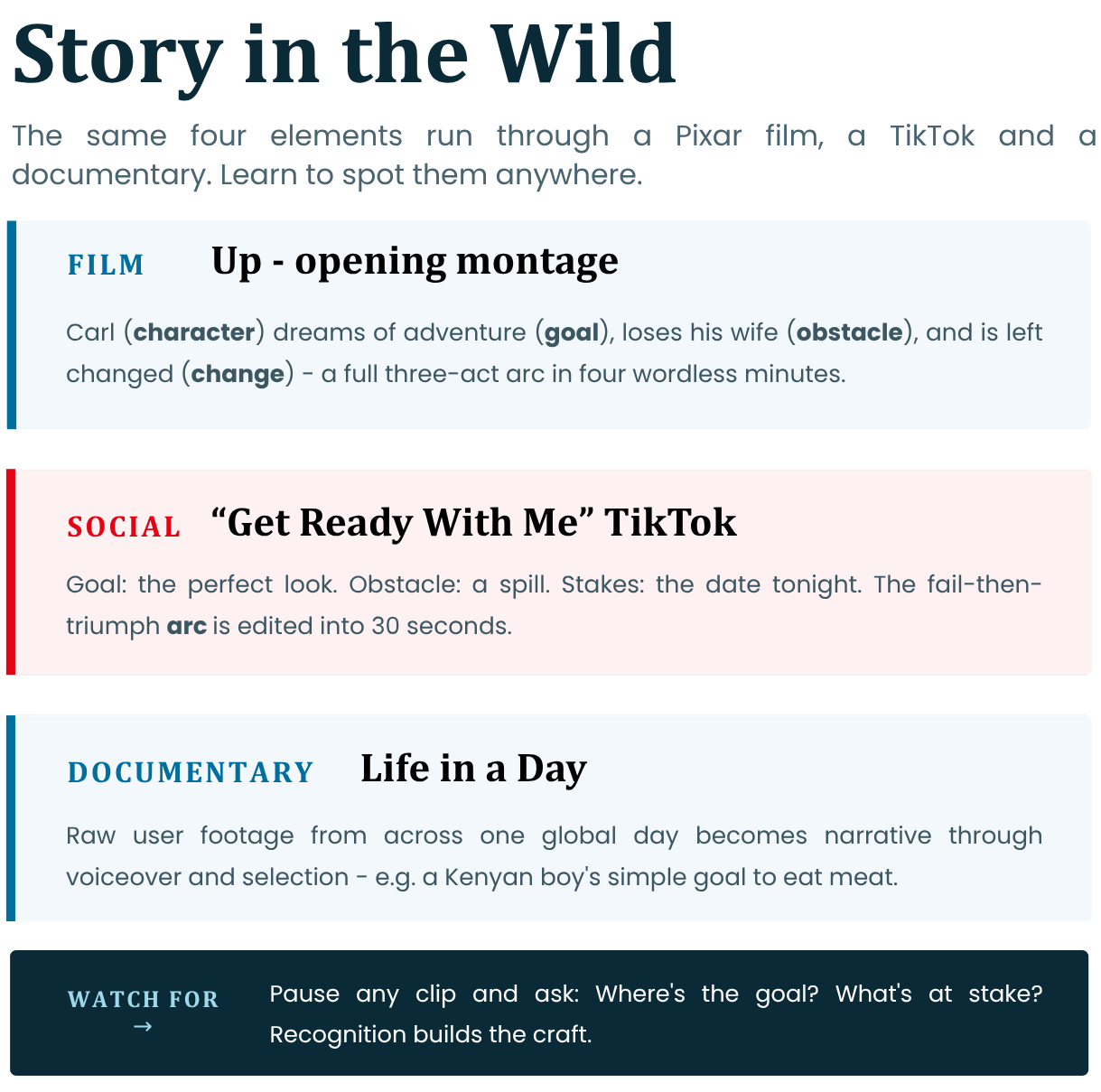
- Film: *Up* opening (Pixar): Elderly Carl (character) loses wife (obstacle), goal to adventure (change). 3-Act montage crushes hearts.
Watch: Up - Married Life opening scene
Read: Rotten Tomatoes - Carl and Ellie opening sequence
- Social Media: Viral TikTok "Get Ready With Me" fails → triumphs: Goal (perfect look), obstacle (spill), stakes (date), edited arc.
- Documentary: *Life in a Day* clips: Raw event (global day) → narrative via voiceover/selection (e.g., Kenyan boy's goal to eat meat).
Watch/analyse: Pause for "Spot goal? Stakes?" Builds recognition.
Reference: *Life in a Day* (YouTube/Kevin Macdonald, 2011) exemplifies user footage into narrative.
Watch: Life in a Day 2010 - full film
Read: The Guardian - Life in a Day background
Explore Further: Life in a Day YouTube channel
Practice: Link to 1-min clips for self-review.
7. Exercise: Transforming a Simple Real-Life Event into a Story Outline + Audio-Visual Focus
1. Pick Event: Mundane, e.g., "morning commute".
2. Identify Elements: Character (you), Goal (arrive on time), Obstacle (bus delay), Change (learn patience).
3. 3-Act Outline:
- Beginning: Alarm, rush out.
- Middle: Crowded bus, phone drama.
- End: Arrive, reflect positively.
4. Amp Stakes/Conflict: "Miss class? Fail project?"
5. Audiovisual Layer: Note shots (close-up frustration), sound (horns), edit (montage).
Film your outlined event (30s raw), add narrative voiceover next module.
-
-
MODULE 1 ASSIGNMENT
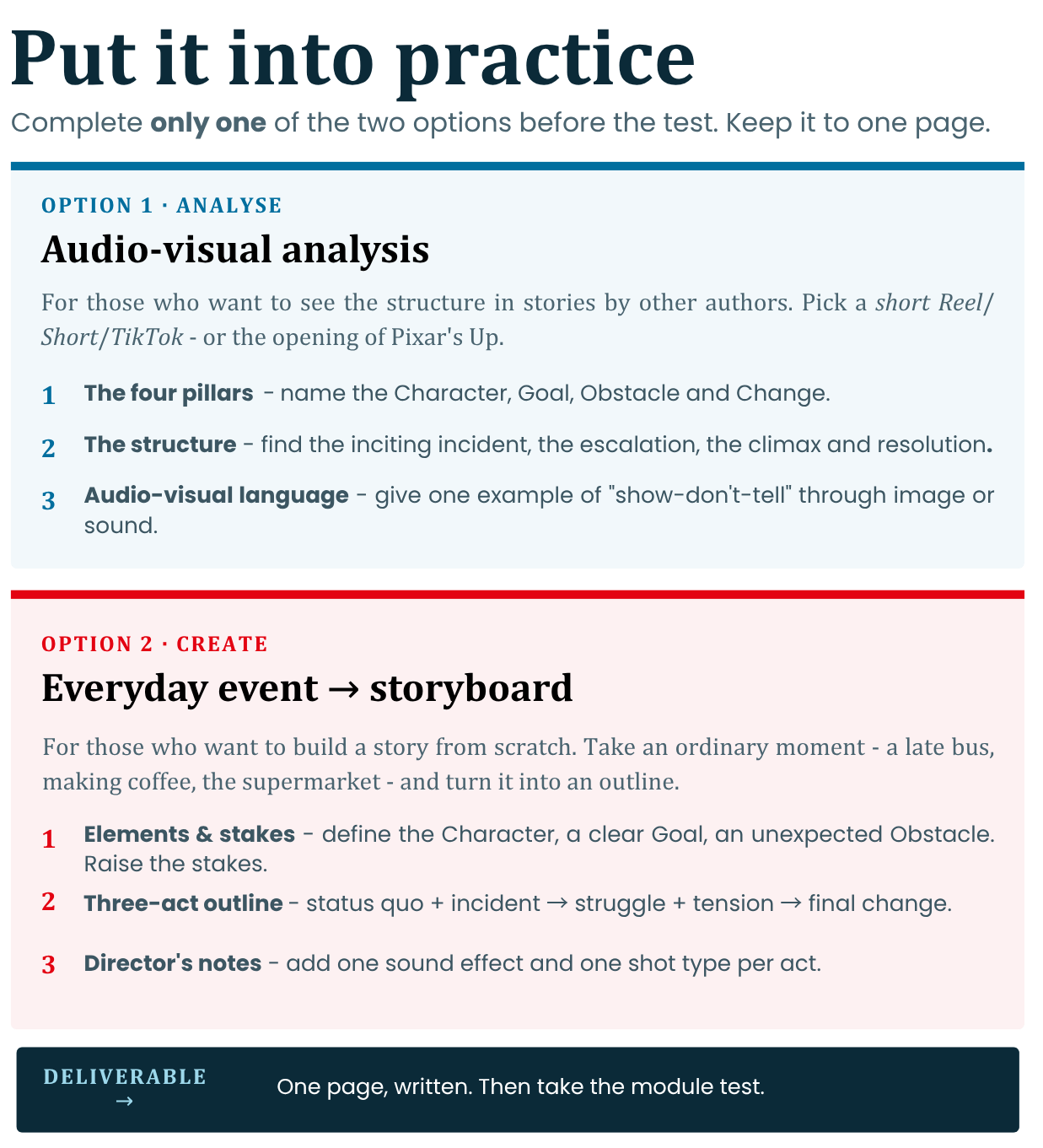
Choose and complete only one of the two options of your choice. This task will help you put what you have learned into practice before moving on to the test.
Option 1: Audio-visual analysis of an existing story
-
Description: This option is suitable for people who want to develop their ability to “see” the structure of stories created by other authors.
-
Your task: Choose a short video from social networks (TikTok, Instagram Reels, YouTube Shorts) or analyse the opening video from the Pixar film Up mentioned in the module. Describe the following elements in writing in a volume of up to one page:
1. The Four Pillars: Who is the Character? What is their specific Goal? What Obstacle does they encounter (external or internal) and what is the Change in them at the end?
2. The Structure: What is the intriguing incident in the Beginning? How does the conflict escalate in the Middle? What is the climax and resolution in the End?
3. Audio-visual language: Provide at least one example of how the creator uses visuals (e.g., close-up for emotion) or sound (e.g., diegetic sound from the environment) to “show, not tell” the story.
Option 2: Turning an Everyday Event into a Storyboard
-
Description: This option is for those who want to step into the role of authors and build their own story from scratch.
-
Your task: Choose a completely ordinary everyday event (e.g., shopping at the supermarket, waiting for a late bus, trying to make coffee in the morning). Turn it into a compelling Outline by writing down:
1. The Elements and Stakes: Define the Character (you or a fictional person). Set a clear Goal and add an unexpected Obstacle. Artificially raise the Stakes – what catastrophically will happen if the goal is not achieved?
2. Three-Act Screenplay: Write out the event in three acts - Climax (introducing the status quo and incident), Climax (the struggle with the obstacle and micro-conflicts, followed by the critical moment when the tension rises), Resolution (the final change/lesson learned).
3. Director's Notes: Add one audio-visual note to each of the three acts - what sound effect will be heard and what type of shot (e.g. wide shot) will you use to transport the viewer to the scene of the event.
-
-